Last updated: October 21, 2026
Quick answer: the best erosion control plants for dry hillsides and wash areas usually come from a mix of 5 plant types: ornamental grasses, groundcovers, shrubs, sedges, agaves, and yucca. For Best Erosion Control Plants for Dry Hillsides and Wash Areas, that mix works better than a single “perfect” plant because it combines root density, surface cover, and structural anchors.
Dry hillsides and wash areas fail in different ways. A hillside sheds water before roots can grab it. A wash gets hit by fast, scouring flow and then dries out again. The plants below are chosen for soil holding, not just drought tolerance, and the trade-off is real: the toughest plants for erosion control are often slower to look full, and some can be prickly, woody, or messy.
If the slope is part of a bigger roof, wall, or hillside project, this article supports the broader xeriscape roof, wall, and slope protection guide.
Key Takeaways
- The most useful erosion-control plants are the ones that knit soil together with roots and runners, not the ones with the prettiest bloom.
- On dry slopes, a mixed planting usually outperforms a single species because it holds soil at different depths.
- In wash areas, plants need flexible stems, deep roots, and room to recover after brief water surges.
- Establishment watering matters more than mature drought tolerance; most failures happen in the first 1 or 2 growing seasons.
- Some of the strongest soil stabilizers are not lawn substitutes and not tidy front-yard plants.
Which erosion control plants work best on dry hillsides?
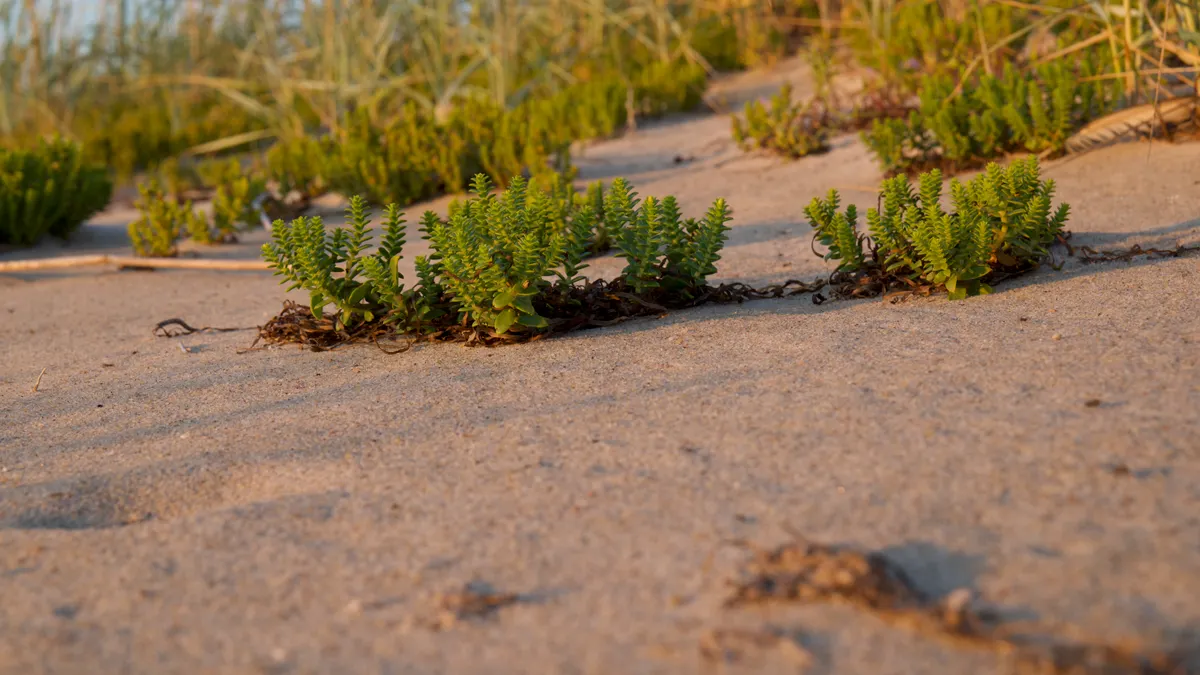
The best plants for dry hillsides are those that form a low, interlocking root mat or a dense clump that slows runoff before it cuts channels. That usually means groundcovers for the top and mid-slope, grasses and sedges for stitching soil together, and shrubs or structural succulents for anchoring larger pockets of ground.
A useful planting on a dry slope is less like a garden bed and more like a fabric. You want roots at multiple levels, leaves that break the force of rain, and spacing that closes in without leaving bare strips. A plant that looks good in a pot but stays sparse for 2 years is a poor erosion choice.
For a hillside, the strongest candidates are often:
- Ornamental grasses such as deer grass or sideoats grama, where climate allows. Their fibrous roots bind loose soil, and their clumps trap sediment.
- Groundcovers such as creeping germander, trailing rosemary in mild climates, or other low, spreading species that root along stems.
- Shrubs with deeper anchoring roots and a wide canopy, especially where the slope is large enough to support them.
- Sedges in places that get a little more moisture or collect runoff from higher up.
- Agaves and yucca as structural plants for very dry, rocky slopes, where you need deep, coarse roots and very low water use.
A common mistake is buying the shortest plant and assuming it will control erosion fastest. Tiny plugs leave soil exposed for months. A larger container, often 1-gallon or 5-gallon stock, gives a faster canopy and usually better first-season coverage, though it costs more and still needs careful watering.
This is not the right page for a soft, lawn-like look. It is also not the best approach for a shaded slope with heavy clay, where waterlogging can kill drought plants before roots knit in.
The planting strategy that actually holds soil
A slope stays put when roots cover the whole surface, not just the spots where holes were dug. The most effective setup is a staggered mix of plants spaced to close in within a few seasons, with the deepest-rooted plants placed where water naturally moves.
Use this order on a dry hillside:
- Start with the structural plants. Place shrubs, agaves, or yucca on contour lines and at breaks in slope. Their larger root systems give the hillside a framework and reduce the chance of long bare runs.
- Fill between them with grasses or sedges. Space them so their mature clumps meet or nearly meet. The goal is to create living check dams that slow water and catch silt.
- Add spreading groundcovers in the open spaces. These plants protect the top few inches of soil, which is where erosion starts after a hard rain or irrigation splash.
- Mulch the exposed soil. Use a rough mulch that stays in place on slopes, not fine material that slides downhill after one watering.
- Water in a wide basin, not a tight ring. A 2- to 4-inch-deep basin around each plant sends water down into the root zone instead of letting it run off.
- Check the slope after the first storm or irrigation cycle. Look for rills, seed washout, or mulch movement and fix them before they deepen.
The planting pattern matters as much as the plant list. A single row across a hill is weak. A staggered grid or offset clusters catch runoff much better because water keeps hitting a root, then a stem, then another root.
A hillside planting that looks sparse for the first season can still be the right one if the roots are strong and the spacing is deliberate. What fails is a layout that leaves long strips of bare soil between plants.
Best erosion control plants for dry hillsides and wash areas
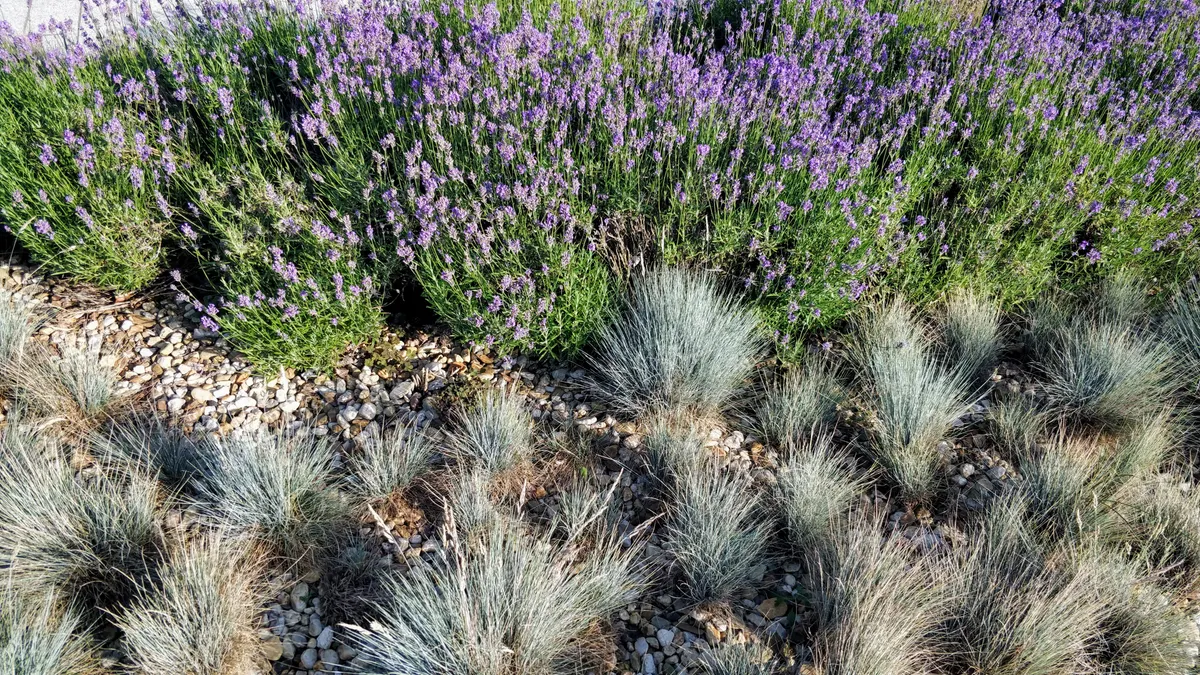
The best erosion control plants for dry hillsides and wash areas are the ones that match the job site: slow runoff on slopes, absorb pulse flows in washes, and survive long dry spells without collapsing. The same plant rarely does all three jobs equally well.
Ornamental grasses
Ornamental grasses are among the better soil-holding plants for dry slopes because their fibrous root systems make a dense underground web. Their tops also slow water and trap debris before it moves downslope.
Good uses:
- Mid-slope bands where you need root density
- Dry drain edges where the soil gets occasional splash
- Transition zones between shrubs and groundcovers
Trade-off: many grasses look best in clumps and can flop or go dormant in extreme heat, which leaves some seasonal gaps. They are also a poor choice where a very formal appearance is the priority.
Groundcovers
Groundcovers are the fastest way to shield bare soil once they knit together. The best ones root along stems or spread in a low mat, which is exactly what a dry slope needs to resist sheet erosion.
Good uses:
- Sunny banks with shallow topsoil
- Between larger anchor plants
- Small terraced sections where runoff is moderate
Trade-off: groundcovers can be slow to close in, and some spread too aggressively if irrigation is heavy. They are not ideal for deep wash bottoms where flood energy can tear them out.
Shrubs
Shrubs give a hillside vertical structure and deeper anchoring roots than most groundcovers. On a broad slope, they act like living anchors that break the length of the grade and interrupt runoff paths.
Good uses:
- Upper slope and contour bands
- Repeated massing on larger hillsides
- Areas where some woody structure is needed to hold soil over time
Trade-off: shrubs take longer to establish and can fail if planted too densely or watered too little in the first year. They are not the quickest fix for a bare bank that needs immediate cover.
Sedges
Sedges are useful where a slope transitions into a wash or drainage line. They tolerate more moisture than true desert plants but still help bind soil with fine, fibrous roots.
Good uses:
- Wash margins
- Drainage swales
- The lower edge of a hillside that occasionally catches runoff
Trade-off: many sedges need more regular moisture than agaves or yucca, so they are not the best choice for the driest top of a hill.
Agaves
Agaves are strong structural plants for dry, rocky slopes because their root systems grip soil well and their form sheds water. They work best as spaced anchors rather than as a continuous cover.
Good uses:
- Very dry, sunny slopes
- Rocky cuts and decomposed granite banks
- Places where you need low water demand and strong visual structure
Trade-off: they are slow to fill in, can be sharp, and do not protect broad bare soil the way a groundcover does. They are bad for narrow paths, play areas, and anywhere people brush past them often.
Yucca
Yucca brings similar structural value to agave, with tall spikes that slow wind and rain while its roots help stabilize lean soil. It is especially useful where the slope is dry enough that softer plants struggle.
Good uses:
- Dry embankments
- Sandy or rocky soil
- The upper edge of a wash where you need toughness more than softness
Trade-off: yucca can spread in a coarse form and may look too stark for small residential beds. It is not the right choice if the goal is a lush, low garden edge.
For reliable background on erosion mechanics and plant establishment, the Natural Resources Conservation Service and university extension publications are worth reading alongside plant-specific advice. The USDA NRCS offers slope and soil guidance at https://www.nrcs.usda.gov/, and university extension resources such as https://extension.arizona.edu/ explain drought planting and soil-water management in practical terms.
How do I keep wash areas from washing out again?
Wash areas need plants that can take brief flow, recover quickly, and trap sediment without turning into a dam. The best plan is usually a layered edge rather than planting directly in the center of the active channel unless the wash only carries water occasionally and lightly.
Use plants along the sides and on higher benches first. That way, the roots reinforce the bank where erosion starts, while the channel stays open enough for water to move through. If a plant sits in the middle of a fast-moving wash, it can be uprooted or become debris that worsens the blockage downstream.
Good wash-area choices include:
- Sedges near the margins
- Shrubs on stable banks above the active flow line
- Grasses in adjacent swales
- Tough, deep-rooted desert plants on dry benches outside the scour path
Avoid stuffing a wash with dense, thirsty planting. A heavy planting in a narrow channel can trap debris and redirect water into the bank. That is the opposite of erosion control.
The right question is not “What grows here?” but “Where does the water actually move?” Mark the high-water line after a storm if you can, or study the scoured line and place plants outside it.
This is also where a professional landscape designer or erosion-control contractor can help if the wash is part of a drainage system serving a house, driveway, or retaining wall. The plant list is only part of the fix when the channel itself is moving soil.
Establishment watering matters more than mature drought tolerance
Establishment watering decides whether erosion control plants knit in or fail, because a plant that never roots deeply cannot hold soil well. Most dry-slope plants need regular deep watering at first, then a slow taper over 6 to 18 months depending on species, container size, and season.
The goal is to water deeply enough that roots follow moisture downward. Short, frequent sprinkles encourage shallow roots, which is exactly what you do not want on a hillside. On a steep slope, that can also cause runoff before the water reaches the root ball.
A practical schedule looks like this:
- Water immediately after planting to settle soil.
- For the first several weeks, water slowly so the basin soaks through without running off.
- Once plants are established, water less often but more deeply.
- After the first season, cut back to what each plant actually needs in your climate and soil.
If the slope is very steep or sandy, consider a temporary erosion blanket or pinned mulch while roots develop. That is not a plant, but it protects the plants long enough for them to do their job.
One mistake worth avoiding is treating all drought plants the same. A yucca and a sedge do not want the same watering pattern. Overwatering can rot one and underwater can stunt the other. The plant label matters, and so does the soil texture under it.
The mistakes that make erosion control planting fail
The biggest mistakes are planting too sparsely, choosing shallow-rooted ornamentals, and stopping watering too soon. Each one costs you soil movement, bare patches, and rework.
Here is what goes wrong and what to do instead:
- Too much open soil between plants: runoff finds the gaps and cuts rills. Use staggered spacing so canopies overlap as they mature.
- Only using one plant type: a single layer of roots usually misses part of the slope. Mix grasses, groundcovers, and a few structural plants.
- Choosing plants for looks only: a plant can be pretty and still be useless against erosion. Pick for root habit, spread, and stem density first.
- Watering like a lawn: shallow irrigation creates shallow roots. Water deeply and less often.
- Putting wash plants in the active channel: the first strong flow can tear them out. Keep most plantings on the banks and edges.
- Expecting instant coverage: many erosion-control plants take at least one growing season to settle in. Use mulch, spacing, and temporary protection to bridge the gap.
The wrong plant in the wrong place can make erosion worse. A loose, upright ornamental may catch wind but do little for soil; a prickly succulent may anchor a small patch but leave the surrounding ground exposed. Good erosion control is a pattern, not a trophy plant.
If the slope is failing in sheets, slumping, or undercutting a structure, plant choice alone may not be enough. In that case, get the drainage and grading reviewed before you plant.
A short list to start with, if you need the safest picks
The safest starting group for dry hillsides is a mix of one or two ornamental grasses, several groundcovers, a few shrubs, and structural accents like agave or yucca. That combination gives you both fast surface cover and deeper anchoring.
If I had to narrow the field by job:
- For broad dry slopes: grasses and spreading groundcovers
- For lower drain edges and dry washes: sedges and tough shrubs
- For very dry rocky sections: agaves and yucca
- For the fastest soil knitting: dense groundcovers plus mulch
The wrong choice for a reader with a tight, highly manicured front yard is often agave or yucca, because the look is coarse and the leaves can be sharp. The wrong choice for a wash bottom is a fragile mat plant that cannot take moving water. The wrong choice for any slope is a plant list that ignores how water actually travels.
A hillside holds when roots, runoff, and plant spacing work together.
Drafted with AI; not yet reviewed by a person.